
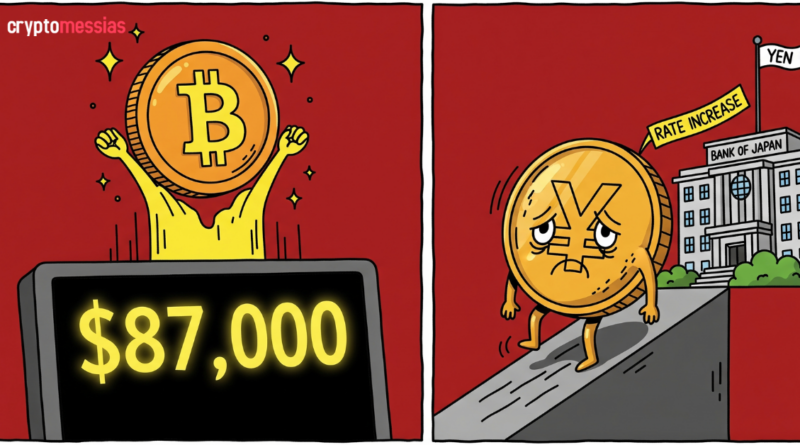
Bitcoin Tops $87,000 While Yen Slips Following Bank of Japan Rate Increase
The Bank of Japan has raised its benchmark short-term interest rate by 0.25% points to 0.75%, marking the highest level in approximately three decades as the nation continues its gradual exit from ultra-accommodative monetary policy.
Bitcoin gained strength while the Japanese yen declined following the Bank of Japan’s expected rate decision. The cryptocurrency rose from $86,000 to $87,500 before stabilizing around $87,000.

The BOJ’s policy statement recognized that inflation has persistently exceeded the 2% target, driven by elevated import costs and strengthening domestic price pressures. Despite this increase, policymakers stressed that inflation-adjusted interest rates remain in negative territory, meaning monetary conditions continue to be supportive of economic activity.
Following the announcement, the yen weakened from 155.67 to 156.03 against the dollar. The subdued market reaction was expected, as the rate hike had been widely forecasted and currency speculators had already established long yen positions over recent weeks, limiting any sharp movements.
Also Read :-Why Is the Crypto Market Down Today?
Some market participants had worried that the rate increase might strengthen the yen and trigger a reversal of yen carry trades—a popular strategy where investors borrow in yen at low rates to purchase higher-return assets like U.S. technology stocks, Treasury securities, and emerging market bonds. Japan’s prolonged period of near-zero or negative rates made the yen an ideal funding currency, supporting global market liquidity and risk appetite.
However, these concerns appear to be exaggerated. Even after the rate hike, Japanese interest rates remain substantially lower than U.S. rates, making a large-scale unwinding of carry trades unlikely.
Important Disclaimer
This article is for informational and educational purposes only and should not be considered financial advice. Cryptocurrency investments, including Dogecoin, are highly speculative and carry substantial risk of loss. The predictions and scenarios discussed in this article are based on analysis of current market conditions, historical patterns, and various factors, but they are not guarantees of future performance.
Comments are closed.